Hard surfaces reflect
Concrete, glass, tile, and painted plaster tend to return more sound energy into the room.
Sound has to go somewhere.
Build a room, change its surfaces, listen through your microphone, or clap once to estimate how quickly sound dies away.
Microphone audio is processed locally in your browser. Nothing is uploaded.
01
Room simulator
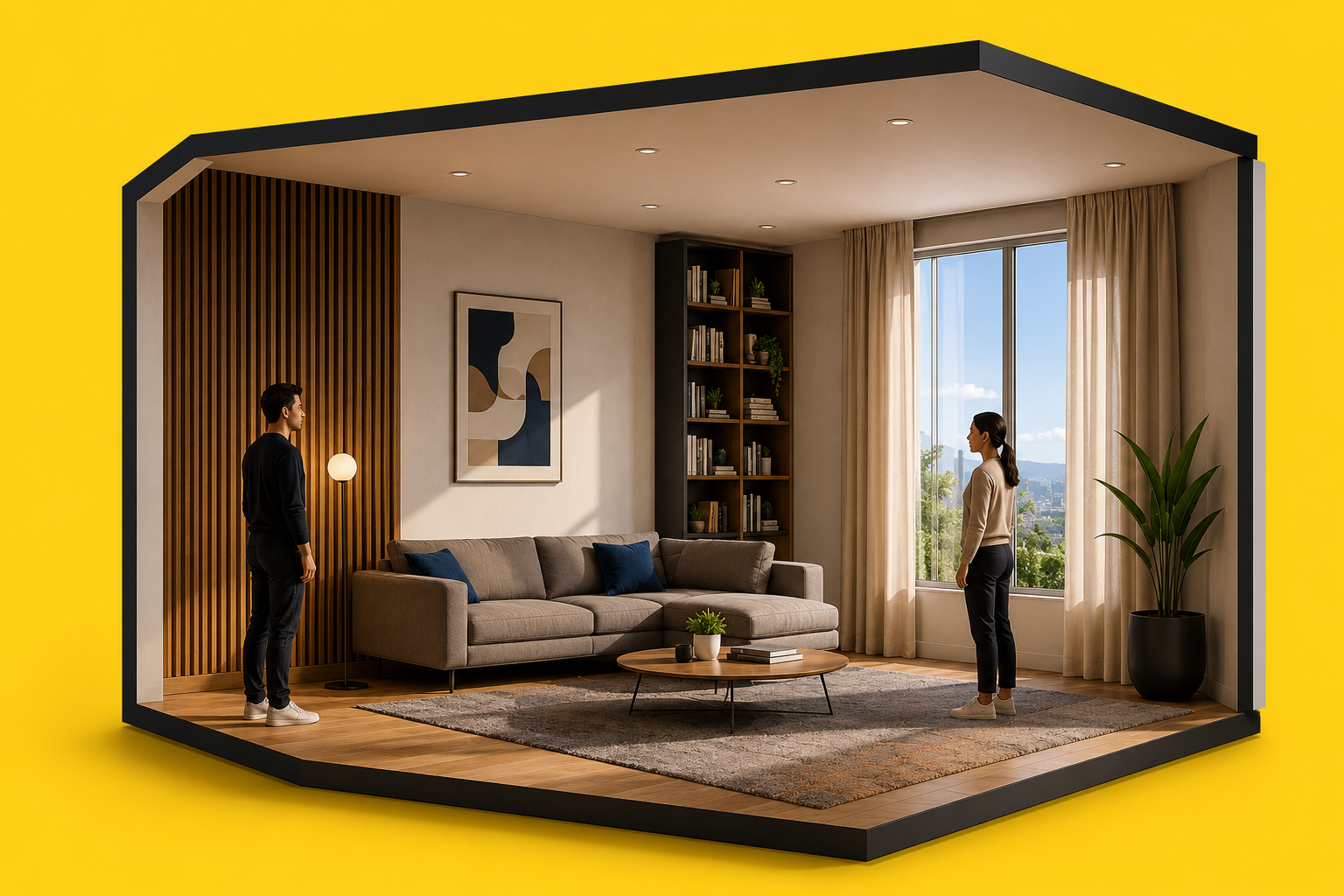
Hard surfaces return more sound. Soft and irregular surfaces absorb or scatter more of it. Build a space and watch the predicted reverberation change.
Hear the simulation
Your microphone can be routed through a browser-generated reverb based on the room above. Change the room while monitoring and hear the decay update.
Headphones are strongly recommended to prevent speaker-to-microphone feedback.
Microphone is off.
02
Clap test
Your device can listen to one clap and estimate how quickly its sound decays. It is intentionally approximate: microphones, browser processing, background noise, and room geometry affect the result.
Avoid music, fans, and obvious background noise where possible.
About 1–2 meters is useful when the room allows it.
One sharp clap works better than repeated clapping.
The recording stays in this browser tab and is discarded after analysis. It is never uploaded.
Allow microphone access, then clap once after the countdown.
03
What you’re hearing
Some reflected sound arrives quickly enough to blend with the original sound. A long series of those reflections is perceived as reverberation.
Concrete, glass, tile, and painted plaster tend to return more sound energy into the room.
Carpet, heavy curtains, upholstered furniture, and acoustic treatment can reduce reflected energy.
Bookshelves and uneven surfaces send reflections in many directions instead of behaving like one flat mirror.
SIMPLIFIED MODEL USED HERE
The simulator estimates decay from room volume and total effective absorption.
The simulator uses simplified average absorption values, and the microphone test is not a substitute for calibrated acoustic measurement equipment.